The Death of Expertise: The Campaign Against Established Knowledge and Why it Matters by Tom Nichols
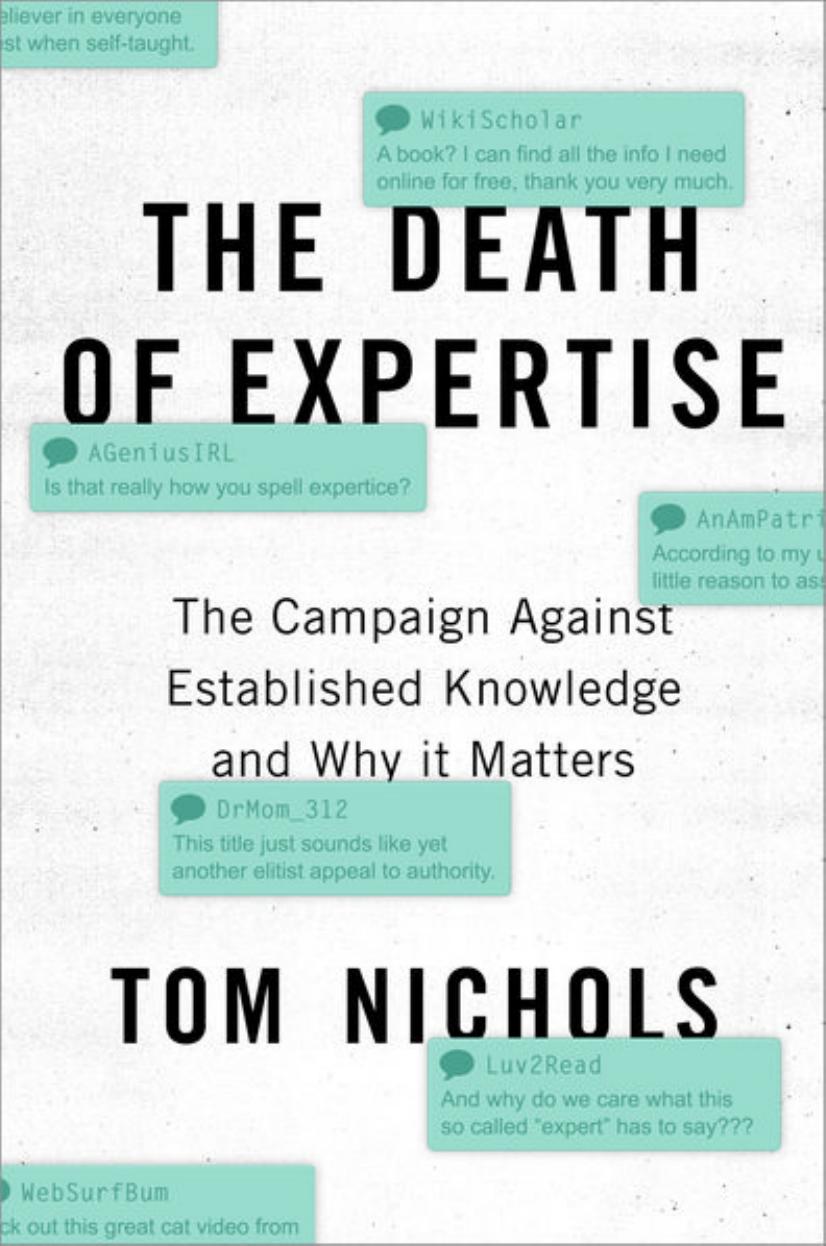
Author:Tom Nichols [Nichols, Tom]
Language: eng
Format: epub, mobi, pdf
Publisher: Oxford University Press
Published: 2017-01-31T22:00:00+00:00
I UNFRIEND YOU
Learning new things requires patience and the ability to listen to other people. The Internet and social media, however, are making us less social and more confrontational. Online, as in life, people are clustering into small echo chambers, preferring only to talk to those with whom they already agree. The writer Bill Bishop called this “the big sort” in a 2008 book, noting that Americans now choose to live, work, and socialize more with people like themselves in every way. The same thing happens on the Internet.
We’re not just associating with people more like ourselves, we’re actively breaking ties with everyone else, especially on social media. A 2014 Pew research study found that liberals are more likely than conservatives to block or unfriend people with whom they disagreed, but mostly because conservatives already tended to have fewer people with whom they disagreed in their online social circles in the first place. (Or as a Washington Post review of the study put it, conservatives have “lower levels of ideological diversity in their online ecosystem.”)18 Liberals were also somewhat more likely to end a friendship over politics in real life, but the overall trend is one of ideological segregation enabled by the ability to end a friendship with a click instead of a face-to-face discussion.
This unwillingness to hear out others not only makes us all more unpleasant with each other in general, but also makes us less able to think, to argue persuasively, and to accept correction when we’re wrong. When we are incapable of sustaining a chain of reasoning past a few mouse clicks, we cannot tolerate even the smallest challenge to our beliefs or ideas. This is dangerous because it both undermines the role of knowledge and expertise in a modern society and corrodes the basic ability of people to get along with each other in a democracy.
Underlying much of this ill temper is a false sense of equality and the illusion of egalitarianism created by the immediacy of social media. I have a Twitter account and a Facebook page, and so do you, so we’re peers, aren’t we? After all, if a top reporter at a major newspaper, a diplomat at the Kennedy School, a scientist at a research hospital, and your Aunt Rose from Reno all have an online presence, then all of their views are just so many messages speeding past your eyes. Every opinion is only as good as the last posting on a home page.
In the age of social media, people using the Internet assume that everyone is equally intelligent or informed merely by virtue of being online. As the New York Times movie critic A. O. Scott has put it,
On the Internet, everyone is a critic—a Yelp-fueled takedown artist, an Amazon scholar, a cheerleader empowered by social media to Like and to Share. The inflated, always suspect authority of ink-stained wretches like me has been leveled by digital anarchy. Who needs a cranky nag when you have a friendly algorithm telling you,
Download
The Death of Expertise: The Campaign Against Established Knowledge and Why it Matters by Tom Nichols.mobi
The Death of Expertise: The Campaign Against Established Knowledge and Why it Matters by Tom Nichols.pdf
This site does not store any files on its server. We only index and link to content provided by other sites. Please contact the content providers to delete copyright contents if any and email us, we'll remove relevant links or contents immediately.
| Anthropology | Archaeology |
| Philosophy | Politics & Government |
| Social Sciences | Sociology |
| Women's Studies |
Nudge - Improving Decisions about Health, Wealth, and Happiness by Thaler Sunstein(7689)
The Fire Next Time by James Baldwin(5424)
iGen by Jean M. Twenge(5407)
Adulting by Kelly Williams Brown(4564)
The Sports Rules Book by Human Kinetics(4377)
The Hacking of the American Mind by Robert H. Lustig(4369)
The Ethical Slut by Janet W. Hardy(4240)
Captivate by Vanessa Van Edwards(3837)
Mummy Knew by Lisa James(3686)
In a Sunburned Country by Bill Bryson(3530)
The Worm at the Core by Sheldon Solomon(3483)
Ants Among Elephants by Sujatha Gidla(3459)
The 48 laws of power by Robert Greene & Joost Elffers(3229)
Suicide: A Study in Sociology by Emile Durkheim(3014)
The Slow Fix: Solve Problems, Work Smarter, and Live Better In a World Addicted to Speed by Carl Honore(3001)
The Tipping Point by Malcolm Gladwell(2909)
Humans of New York by Brandon Stanton(2864)
Handbook of Forensic Sociology and Psychology by Stephen J. Morewitz & Mark L. Goldstein(2692)
The Happy Hooker by Xaviera Hollander(2683)
